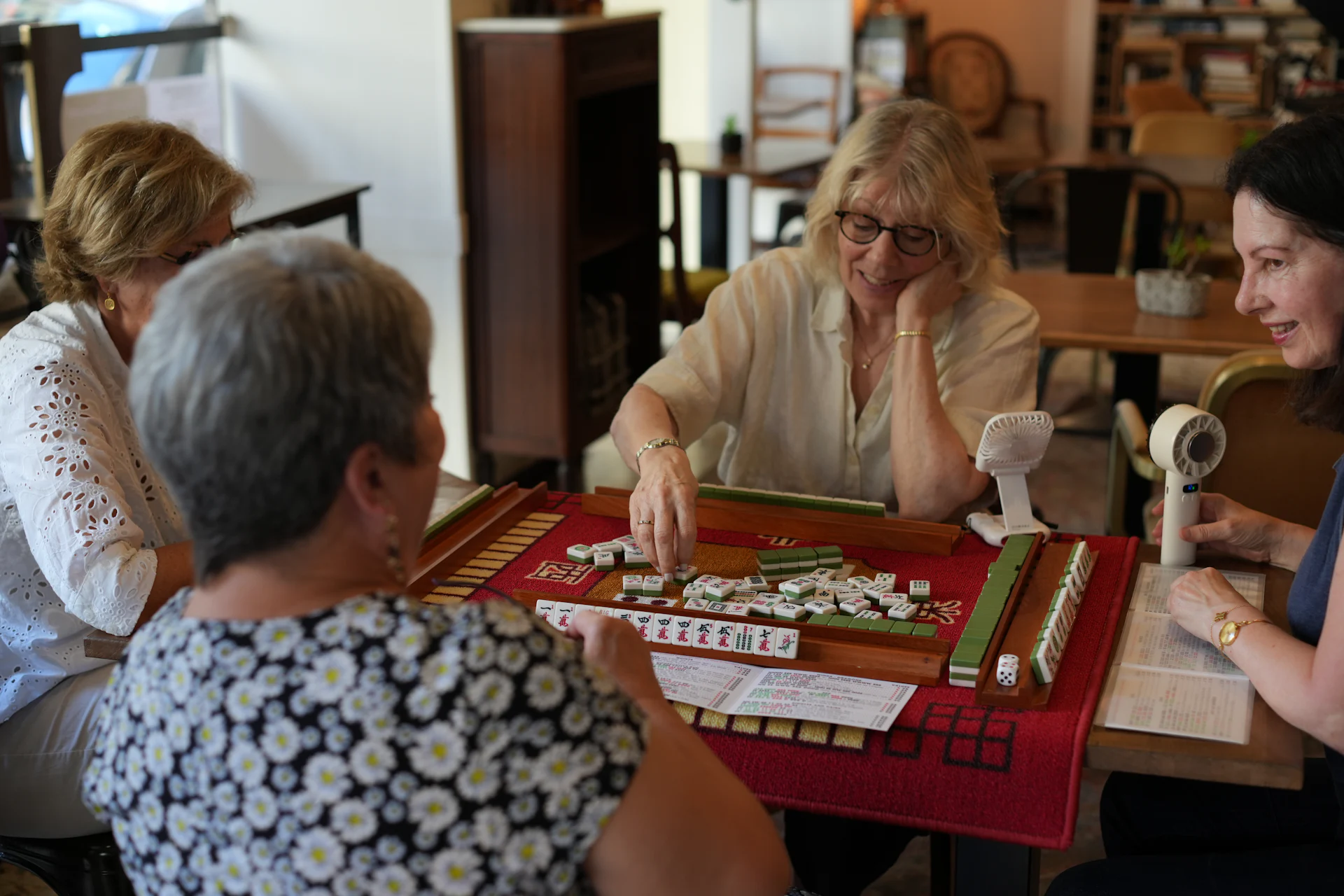
How to Play American Mahjong for Beginners
How to play American Mahjong from the first deal: the wall, the Charleston, draw-and-discard, and the rule about Jokers that catches out every beginner.
American Mahjong has a reputation as the hard version. It is not the hard version — it is the most rule-bound version, which is a different thing. The sequence is the same every time you sit down, and that is what makes it learnable.
What trips up beginners is that two things are happening at once. You are playing a tile game, and you are matching against a card. This guide walks through both, in the order you actually meet them.
If you already play the Chinese game, the differences come down to chows, Jokers and the card — American Mahjong vs Chinese Mahjong rules takes that comparison apart.
A note on the name. You will see this game written both ways: mah jongg, with two g’s, the way the National Mah Jongg League spells it, and mahjong, the older and more common spelling everywhere else. Same game, same tiles, same rules — search for either.
What you need before you start
Four things, and only one of them is the tiles:
- A 152-tile set, including eight Jokers. If you are checking a set you already own, how many tiles an American set has covers the count and what to look for.
- Four racks — one per player. American Mahjong is played standing up, not flat on the table. Choosing mahjong racks and pushers covers how to match one to the tiles you already own.
- Two dice — for choosing the dealer and deciding where the wall is broken.
- The current year’s NMJL card, published by the National Mah Jongg League each spring.
Our American Mah Jongg sets ship in the 166-tile retail configuration: the 152-tile playing set plus 14 spares, so one lost Joker does not retire the whole set.
The card is the rulebook
This is the single biggest difference from every other mahjong game: American Mahjong has no fixed winning hands.
Instead the League publishes a card each year listing that year’s valid hands, and everyone at the table plays from the same list. You are not building a strong hand — you are building one of the hands printed on the card.
Two consequences for a beginner:
- You cannot win by accident. A perfectly formed hand that is not on the card is worth nothing.
- Reading the card is most of the skill. How to read the NMJL card covers its structure.
Setting up the table
- Shuffle and build the walls. All 152 tiles face down. Each player builds a wall nineteen tiles long and two high in front of their rack, and the four walls form a square.
- Choose the dealer. The dice decide who is East, and where the wall is broken.
- Deal. Four tiles at a time, starting with East and moving to the right, until everyone holds twelve. Then East takes two more and the other three take one each. Everyone holds thirteen; East holds fourteen.
- East does not discard yet. The Charleston comes first.
The Charleston
The Charleston is the part of American Mahjong with no equivalent anywhere else. Before a single tile is drawn from the wall, every player passes tiles around the table.
The first Charleston is mandatory, and it runs as three passes of three tiles:
| Pass | Direction |
|---|---|
| First | three tiles to the right |
| Second | three tiles across the table |
| Third | three tiles to the left |
Then, if all four players agree, a second Charleston runs the same sequence in reverse — left, across, right.
Finally there is an optional courtesy pass: you may swap up to three tiles with the player sitting across from you, by mutual agreement.
Two details people get wrong:
- Jokers may never be passed — not in the Charleston, not in the courtesy pass.
- Blind passing — sending on tiles you have not looked at — is legal only on the final pass of each Charleston, and never on an across pass.
Why it exists: the Charleston breaks up the luck of the deal. Without it, a bad first hand would be a bad whole game.
Your turn: draw, then discard
Play moves to the right, starting with East, who makes the first discard.
Every turn follows the same two beats:
- Take a tile — either draw from the wall, or call the tile another player just discarded.
- Discard one — face up, and name it out loud. A tile counts as discarded once it has been named, or as soon as it touches the table.
You hold thirteen tiles between turns and fourteen on your turn. That one-in, one-out churn is the whole engine of the game.
Calls: pungs and kongs — but no chows
You can take a discarded tile instead of drawing. American Mahjong allows far fewer calls than the Chinese game:
- Pung — three of a kind. Claimable from any discard.
- Kong — four of a kind. Claimable.
- Quint and sextet — five or six of a kind, where the card asks for one.
- Chow — does not exist in American Mahjong. You cannot claim a tile to complete a run of three.
That last one changes everything. With no runs to build, an American hand is assembled from matched groups and individual named tiles — which is exactly why the card can be as specific as it is, and why the game plays more like collecting than building.
Jokers: wild, but not everywhere
Jokers are the eight wild tiles in an American set, and they are the rule beginners get wrong most often:
Jokers may only be used inside a pung, a kong, a quint or a sextet. They can never stand in for a single tile, and they can never complete a pair.
A pair must be two natural tiles, always. Break that rule and your hand is dead — unplayable, and you start again.
This is also why the Joker count is the number to verify on a new set. Eight is what the card assumes.
How you win
You win by being the first to hold fourteen tiles that exactly match one complete line on the card.
Not close to a line, and not parts of two lines added together — one line, whole.
When you complete it you call “Mah Jongg”, expose your hand, and the table checks it against the card. If it matches, the other three players pay according to the value printed on that line. If it does not, you are dead.
Five mistakes beginners make
- Not reading the card before the first deal. Pick two or three lines you could aim for before you draw a single tile.
- Treating Jokers as fully wild. They cannot make a pair. A large share of first-time “wins” fail on this one rule.
- Trying to skip the Charleston because the hand looks good. It is not optional.
- Passing a Joker. Against the rules, and it advertises your hand to the table.
- Chasing one line for too long. The card offers dozens of options. Switch when the tiles tell you to.
What to buy for your first set
For learning, the card matters more than the equipment — but three things are worth checking before you buy:
- The tile count. 152 to play, however the box words it. The full breakdown is worth reading first.
- The tile size. 30 × 23 × 13 mm is standard; larger is easier to read across a table. Tile sizes explained.
- Whether racks are included. You need four, and they have to match the tile thickness or the tiles will not stand up.
Play one hand, then another
American Mahjong rewards repetition more than study. Read the card, sit through one Charleston, and the structure stops feeling arbitrary — by your third hand you will be tracking discards without noticing you are doing it.
And the good news for anyone buying equipment: only the card changes year to year. The tiles you buy today are still the right tiles in ten years.
First Game Questions
How do you play American Mahjong for the first time?
Learn the card before you learn the tiles. American Mahjong is won by matching one complete line on the current NMJL card, so read a few lines and pick one to aim for. Then build the walls, deal thirteen tiles each, run the Charleston, and start drawing and discarding.
What is the Charleston in American Mahjong?
A mandatory opening phase in which every player passes three tiles three times: to the right, then across the table, then to the left. A second Charleston, in the reverse direction, is optional and needs all four players to agree. Jokers may never be passed at any point.
How many tiles do you start with in American Mahjong?
Thirteen, except for the dealer, who starts with fourteen and discards first. You hold thirteen between turns and briefly fourteen on your turn — the same draw-one, discard-one rhythm every mahjong game uses. American Mahjong simply adds the Charleston before that first discard.
Can Jokers be used anywhere in a hand?
No. Jokers are wild only inside a pung, a kong, a quint or a sextet. They can never stand in for a single tile, and they can never complete a pair. A hand that breaks that rule is dead. It is also why the Joker count matters so much — eight is the number the card assumes.
How do you win at American Mahjong?
Be the first to hold fourteen tiles that exactly match one complete line on the current year's NMJL card. You cannot combine parts of two lines. When you complete it you call Mah Jongg, expose your hand, and the table checks it against the card before anyone pays.
Is it mah jongg or mahjong?
Both. Mah Jongg with two g's is the spelling the National Mah Jongg League uses, so it is what you see on the annual card and in American club play. Mahjong is the older and more common spelling worldwide, and it is what most shops and listings use. Same game, same tiles, same rules.
What does mah jongg mean?
The name comes from Chinese, where the older southern name for the game translates literally as "little sparrows". The modern Chinese name is different, but both begin with the same "mah" sound — and that is the syllable English borrowed for the game.
Questions about your own table?
We make American Mahjong sets factory-direct and quote single sets as readily as full cartons. No order is too small to ask about.