Mahjong Rules and Tiles: A Beginner's Guide
Learn mahjong rules and tiles together: the 144-tile set explained, what chow, pung and kong mean, and how a winning hand is actually shaped.
Mahjong looks intimidating from across the room. Four players, a wall of clattering tiles, a vocabulary of words like pung and kong being shouted over the noise. But strip away the regional variations and mahjong is built on a remarkably small set of ideas — and once you can name the tiles and follow the turn order, you can sit down at almost any table in the world.
That is what this guide covers. First the tiles, because you cannot play a game you cannot read. Then the rules, layered the way they actually work: the shared framework every version of mahjong uses, followed by the specific rules that make each major style different.
A game with one name and many rulebooks
The single most useful thing to understand before anything else: there is no universal mahjong rulebook. “Mahjong” is a family of games, the way “poker” is. Hong Kong mahjong, Chinese Competition Rules, Japanese riichi, and American Mahjong all use closely related tiles, but they score differently, restrict different moves, and demand different things from a winning hand.
Almost every argument at a mahjong table comes from two people assuming their local rules are the default. So the first question at any new table is not “what are the rules?” but “which ruleset are we playing?” Write the answer down before you deal.
The sharpest version of that split is Chinese Mahjong against American Mahjong — the same box of tiles, almost nothing else in common. American Mahjong vs Chinese Mahjong rules takes that comparison on its own.
The good news: the foundation is shared, and it is smaller than it looks.
Mahjong tiles: the complete set explained
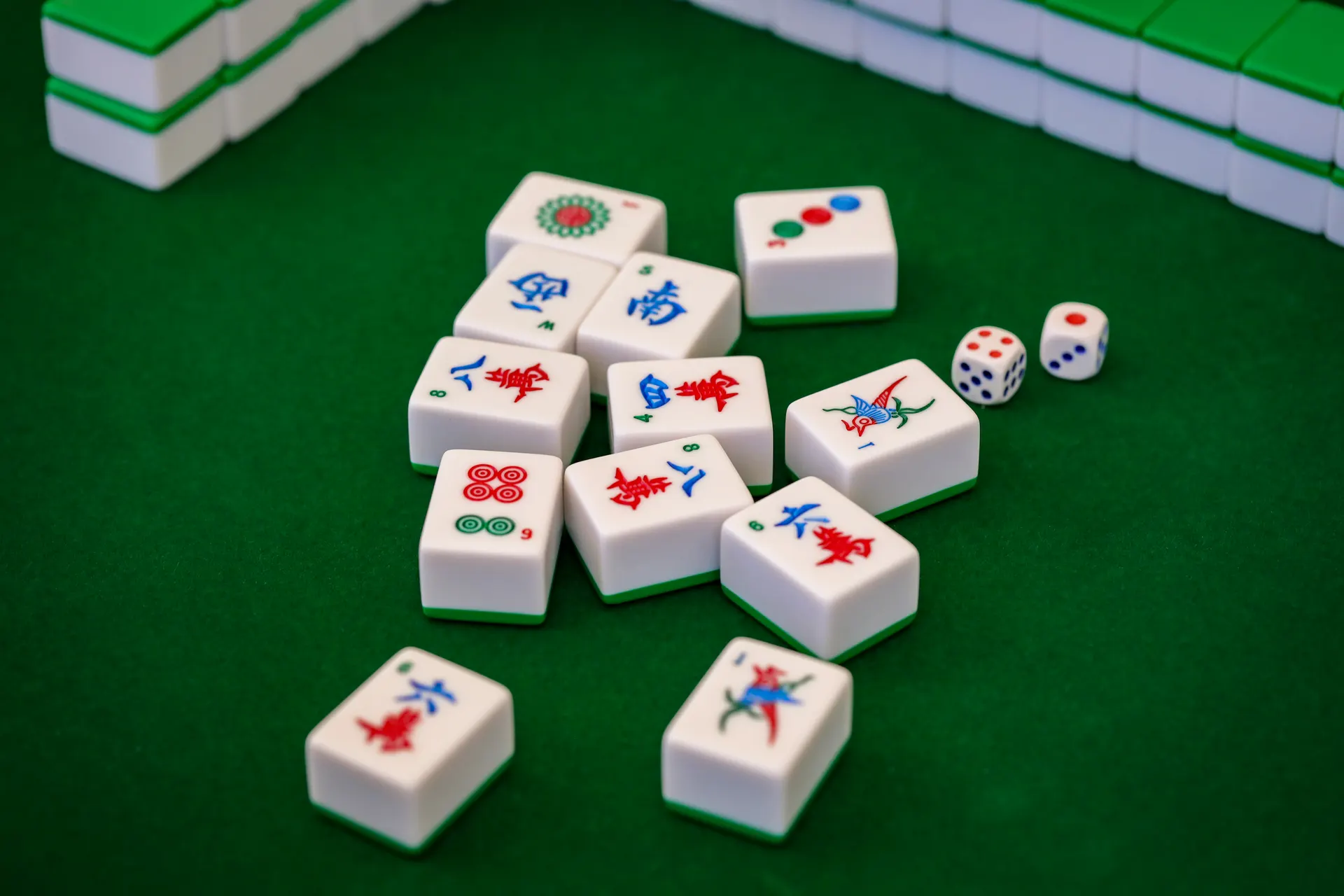
A standard Chinese mahjong set contains 144 tiles. Those 144 break into four families, and each family behaves differently — which is exactly why tile recognition matters more than memorisation. Once you know a tile’s family, you know what it can and cannot do in your hand.
The three numbered suits
Each suit runs from 1 to 9, with four identical copies of each rank:
| Suit | Also called | What is on the tile |
|---|---|---|
| Dots | Circles, pin | Circular patterns representing coins |
| Bamboo | Bams, sou | Sticks of bamboo — the 1 is usually a bird |
| Characters | Craks, man | A Chinese numeral above the character 萬 |
Three suits × nine ranks × four copies = 108 tiles.
The rule that trips up beginners: a sequence must stay inside a single suit and run consecutively. 1-2-3 of Dots is valid. 8-9-1 of Dots is not — the suits do not wrap around.
Honour tiles: winds and dragons
Honours are the 28 tiles that carry no number:
The four winds (four copies each, 16 total) — East, South, West, North. In every four-player ruleset, winds are seats, not just tiles. Your seat wind rotates, and matching your own seat wind or the prevailing wind usually increases what your hand is worth.
The three dragons (four copies each, 12 total) — Red, Green, and White. The dragons reached their modern form around 1890.
Here is the crucial constraint: honours can form triplets and quads, but never sequences. There is no such thing as a Red-Green-White dragon run. If you are holding two lone dragons, your only path is to draw a third.
Bonus tiles: flowers and seasons
The final 8 tiles are the flowers and seasons — four of each, one per player, and the artwork differs in every set. They are not part of a hand’s structure. You never meld them, never discard them strategically, and never build toward them. When you draw one, you set it aside as a bonus and draw a replacement tile.
Bonus tiles were not universally accepted until the 1920s, which is why plenty of sets omit them entirely. Remove them and you get the 136-tile set used by most Chinese and Japanese play.
Tile counts by variant
| Set type | Tiles needed to play | Notes |
|---|---|---|
| Standard Chinese | 144 | Includes flowers and seasons |
| Japanese riichi | 136 | No flowers; often adds red fives |
| American Mahjong | 152 | Adds jokers, racks and an annual card; sets ship as 166 with spares |
This is the point where buyers and players most often get confused, so it is worth being precise. 152 is what American Mahjong needs to play. Sets sold in the United States routinely ship more than that, because makers include spare jokers and blank tiles so a single lost piece does not retire the whole set — which is why the number on the box is often higher than the number in the rulebook. We explain the full American tile count separately, including what to check before you accept a delivery.
American Mahjong also runs on an annual card published by the National Mah Jongg League, treats jokers as wild tiles, and — notably — has no chows at all. If you are new to the American game specifically, how to read the NMJL card walks through the card itself.
Reading a tile at a glance
You do not need to translate the characters to play. A quick recognition order:
- Is there a number? No number means honour or bonus — stop there.
- What colour and pattern? Dots read as circles, bamboo reads as sticks, characters carry the 萬 glyph.
- Is it a wind or a dragon? Winds are directional characters; dragons are red, green, or a blank framed white tile.
- Count the copies you have seen. Only four of each exist. Tracking them is the entire skill ceiling of the game.
Mahjong rules: the shared framework
Underneath the regional differences, the turn structure is nearly identical everywhere.
1. Build the wall
Players shuffle all tiles face-down and build four walls of stacked tiles forming a square. Dice determine where the wall is opened, though the exact counting formula differs by ruleset.
2. Deal the hands
East is the dealer. In most four-player styles, East starts with 14 tiles while the other three hold 13, which is why East makes the first discard.
3. The turn: draw, then discard
Play moves counter-clockwise. Every normal turn follows the same two-beat rhythm:
- Draw one tile from the wall
- Discard one tile face-up into the centre
You always hold 13 tiles between turns (14 during your turn, briefly). That constant churn — one in, one out — is the whole engine of the game.
4. Calls: chow, pung, kong
You can take a tile another player discards instead of drawing. This is “calling”, and it is the vocabulary everyone hears first:
- Chow — you complete a three-tile run in one suit using the discarded tile. Usually claimable only from the player on your left.
- Pung — you complete a three-of-a-kind. Claimable from any player.
- Kong — you complete a four-of-a-kind. Claimable from any player, or formed from a pung you already hold.
Kong has a catch: it uses four physical tiles as a single group, so it breaks the draw-one-discard-one rhythm. You draw a replacement tile to compensate.
The real cost of calling is information. When you call, you flip those tiles face-up. Everyone now knows exactly what you are building, and your hand may become restricted by rules about open versus concealed hands. Beginners call far too eagerly. A good default in your first games: call only when the tile clearly completes a group you already committed to.
5. The winning hand shape
The default target is four groups plus one pair — 14 tiles total.
A “group” is normally a chow, a pung, or a kong. The pair is two identical tiles. Some variants accept special hands that break this shape entirely, and American Mahjong abandons it as the default altogether — but four groups and a pair is the shape to learn first.
6. Declaring the win
You win by drawing the final tile yourself or by claiming a discard that completes your hand. Then you reveal everything and the table verifies the shape.
Here is where beginners get burned: in most rulesets, a valid shape is not automatically a winning hand. There is usually an additional requirement:
| Ruleset | Additional win requirement |
|---|---|
| Hong Kong | A minimum fan value from the scoring chart |
| Chinese Competition Rules | A documented eight-point minimum |
| Japanese riichi | At least one yaku — dora alone does not count |
| American Mahjong | The hand must match a line on the current year’s card |
This trips up new riichi players constantly. You can hold a perfectly formed four-groups-and-a-pair hand and still be unable to win, because it earns no yaku.
7. Score and rotate the dealer
Winning hands are scored by pattern, not by tile count. Flush hands, all-triplets hands, and hands that match your seat wind all score higher than a scattered mix. After settlement, the dealer either retains the seat (on a win) or passes it along.
Mahjong rules by variant: what actually changes
| Variant | Defining feature | Do not assume |
|---|---|---|
| Hong Kong | Meld-based hands with fan scoring | Every table uses the same minimum or payout |
| Chinese Competition Rules | Full competition system, eight-point minimum | It represents all play in China |
| Japanese riichi | Yaku, riichi declaration, furiten, dora, dead wall | Dora alone makes a hand legal |
| American Mahjong | Racks, jokers, the Charleston, an annual card | Four groups plus a pair is the default |
Riichi adds the most machinery: a dead wall, dora indicators that increase a hand’s value, a furiten rule that temporarily blocks you from winning on a tile you already discarded, and the option to declare “riichi” — announcing a ready hand publicly in exchange for scoring bonuses.
American Mahjong is arguably the furthest from the rest. With jokers as wild tiles, no chows, a mandatory Charleston tile-passing phase, and hands defined by that year’s card, it plays like a distinct game that happens to share equipment.
Five mistakes every beginner makes
- Calling too early. Every call reveals information and may lock you into an open hand. Let a few turns pass before you commit.
- Hoarding honour pairs. A lone dragon is dead weight. Two is a project you must finish or abandon early — not on the last five tiles.
- Ignoring what has been discarded. Four copies of each tile exist. If you have seen three, your wait for the fourth is nearly hopeless.
- Chasing a big hand into a loss. A modest win beats a beautiful hand you never complete. Watch the wall count.
- Mixing rulesets mid-game. The most common source of table conflict. Pick one book and stay in it.
If you are buying rather than playing
Most of the confusion above disappears once you know which game you are equipping for, because the equipment differs as much as the rules do.
If you are stocking American sets — for a club, a senior community, a gift shop or a retail shelf — the things that actually matter are the tile count, the tile size and whether the rack matches the tile thickness. How to choose between the five colorways covers what we keep in production, and tile sizes explained covers why the measurements matter more than the photographs. If you are buying by the carton rather than the set, buying mahjong sets in bulk covers mixed cartons and what to verify on delivery.
Start with the tiles, then play one ruleset
Mahjong rewards patience more than talent. Learn the four tile families and the chow-pung-kong vocabulary and you have already cleared the hardest part of the learning curve. Learn the draw-discard rhythm and the four-groups-plus-a-pair target, and you can hold your own at a casual table.
The rest — fan values, yaku, dora, annual cards — is depth you can absorb one game at a time. Pick a single ruleset, play twenty hands in it, and the noise at the next table over will start to sound like a conversation you understand.
If the American game is the one you are about to sit down to, how to play American Mahjong walks through the deal, the Charleston and the Joker rule, starting from the first hand.
Mahjong Rules: Common Questions
How many tiles are in a standard mahjong set?
A standard Chinese set has 144 tiles: 108 suited tiles across three suits, 28 honour tiles, and 8 bonus flower and season tiles. Take the bonus tiles out and you get the 136-tile set used for most Chinese and Japanese play.
Why do different mahjong sets have different tile counts?
Because the regional games are genuinely different games. Chinese mahjong uses 144 tiles including the bonus tiles, Japanese riichi uses 136, and American Mahjong needs 152 to play. Sets sold in the US often ship more than 152 because makers include spare tiles, which is why you see higher numbers on the box.
Can honours be used in a sequence in mahjong?
No. Winds and dragons can only form triplets and quads. A sequence needs three consecutive numbered tiles from a single suit, and the suits do not wrap around, so 8-9-1 of the same suit is not a valid run.
What is the winning hand in mahjong?
The usual shape is four groups plus one pair, for 14 tiles. A group is a chow, a pung or a kong, and the pair is two identical tiles. Many rulesets also require a minimum score or at least one scoring pattern on top of that shape.
What does chow mean in mahjong rules?
A chow is a three-tile consecutive run within one suit, such as 4-5-6 of Bamboo. It is usually claimable only from the player seated immediately to your left, unlike a pung, which any player at the table can claim.
Questions about your own table?
We make American Mahjong sets factory-direct and quote single sets as readily as full cartons. No order is too small to ask about.